Along the red dusty road, four boys run with a ball, a grandfather rides a bicycle, a pair of women walk with barefoot children, and “free-range chickens,” as they would say in the West, scurry around. Asphalt exists only on the main roads leading from the border to major cities and in the cities themselves.
People come to Cambodia to see the giant Hindu temple complex Angkor Wat, founded in the 12th century and functioning as intended (a city-temple with Khmer rulers at its center) until the 15th century. It was rediscovered in the jungles in 1860, covering 200 hectares of breathtaking beauty. Only in 1992 did its new story begin, when it was placed under UNESCO protection. With that came a surge of tourists. Some structures have literally been reassembled stone by stone, while others were preserved thanks to the moat around Angkor, which shielded it from the jungle.
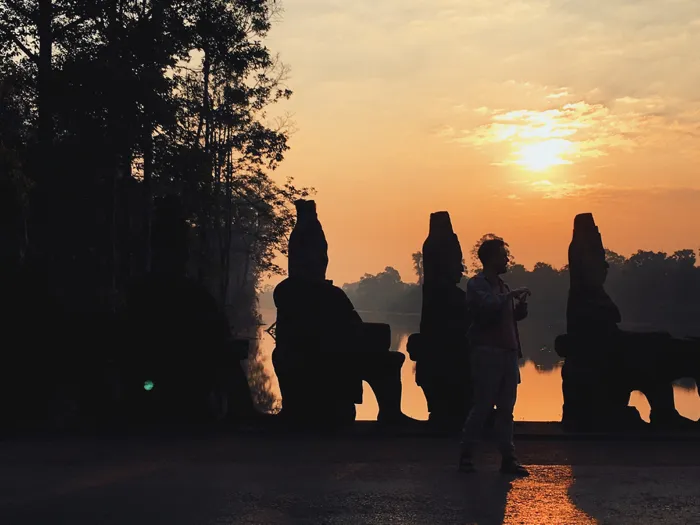
Sunrise at Angkor Wat
Khmer temples were not places of worship gatherings but dwellings for the gods, and access to their central buildings was reserved only for the religious and political elite. Angkor covers an area of 200 km²; recent studies suggest it may have stretched to 3000 km² with a population of up to half a million, making it one of the largest pre-industrial settlements in the world. Today it is an architectural park that includes several ancient cities — Angkor Wat, Angkor Thom, Ta Prohm (where “Lara Croft” was filmed), and others.
The stones used are remarkably smooth, almost like polished marble. The construction was done without mortar, and the blocks fit so tightly that seams are sometimes impossible to detect. Should you come here? Absolutely yes.
Sunrise is the only time when you can see even part of the temples without huge crowds — and without the heat. For this, you’ll need to wake up at 3:30–4:00 to travel from Siem Reap.
Explore the city
It’s not just about Angkor. Cambodia has several major cities, islands, and a coastline for sea travel. The coast is a trip in itself, but in the cities, you can explore street by street. Cambodia was a French colony from 1863 to 1953, and France (as in Vietnam) left traces in details — individual buildings, countless boulangeries with croissants and baguettes, bicycles, and a small but noticeable number of French-speaking expats.
Evening in Siem Reap is a massive party — restaurants (some requiring reservations or a wait), bars, massage salons, street food stalls, and markets.
Cheap fruits
A “one-dollar country.” Fresh coconut — $1. Mango, papaya, dragonfruit — $1. Watermelon — $1. Avocado shake — you guessed it, $1.
A quick health note: rest for the body ends where overeating begins. Indulging more in delicious foods while traveling is fine, especially if it’s fresh fruits and veggies instead of sweets and fried foods. When ordering a fruit shake here, the key is to say no sugar, no milk.
Local food
Dinner is the main meal for Cambodians. Popular among tourists (and occasionally locals) are street barbecues — roadside, simple cafés recognizable by rows of grills. Unlike its neighbors, Cambodia favors beef, and they cook it incredibly well. Alongside any grilled meat comes a large basket of vegetables and greens.
The main sauce is lime juice mixed with salt, sugar, and black pepper. Cambodians are especially proud of their pepper (black, green, white), with specialty shops selling Kampot pepper — considered the best in the world.
I always go for dishes made from vegetables, fruits, meat, fish, or nuts — skipping noodles and rice, even though they’re staples across the region. The flavor combinations reveal much about the country. Cambodia is UNBELIEVABLY delicious. Think green papaya or mango salad, simple leaf salads with peanuts. Try amok — a coconut milk mousse with Khmer curry paste and a local bitter herb, cooked with chicken, beef, or fish. Lok lak — marinated beef stir-fried in a wok, served with fresh vegetables, lettuce, chili, Kampot pepper, and lime juice. Pepper is everywhere — pepper chicken, clay pots with pork snouts stewed in black pepper, and more.
Beyond the city — Tonle Sap
Not only around hotels but within a 20 km radius, there’s always something to see. In Siem Reap, it’s Tonle Sap lake with its floating villages. It’s called Cambodia’s inland sea. These are not just pontoon houses but entire communities on water, complete with schools, police stations, and even temples.
On the way, there are lotus fields. You can stop to taste lotus seeds, watch the cultivation, or snack in a café overlooking the flooded hectares.
There are several villages, though tourists usually hear about just the largest. People truly live here. Life is very poor, but many houses have TVs powered by batteries. There are schools: some for children with parents, and church-run ones for orphans. The children are heartbreaking, but even more so is how they’re used to attract tourists. Around the area are shops that almost coerce you into buying something “for orphans” — a sack of rice ($60; in town it’s $5), noodles, notebooks, pens. On the other hand, the children are fed and educated. Every 3–5 minutes, another tourist boat docks at the schools and shops.
In your own way
Many travelers expect perfect conditions 100%. When it doesn’t happen, they grumble. Flight delayed? Answer emails or get a massage, have a glass of wine. Slow service at a café? Watch the street life — you’re on holiday. No plan? Go to a market, see what locals buy, what products they choose, what they drink. Annoyance won’t help. Create your own ideal conditions.
Read
Don’t be lazy: read at least a few articles or reviews before your first visit. We learned on-site that massage isn’t Cambodia’s strong suit (unlike Thailand or the Philippines). But I had checked running routes in advance — city traffic and dust make running impossible, but reviews revealed that just 300–500 m from any central spot, you can reach a riverside 4 km loop free from city traffic. Even if the road is dirt and the river dry in season, it was still a place to run.